All paradises, all utopias are designed by who is not there, by the people who are not allowed in.
Toni Morrison


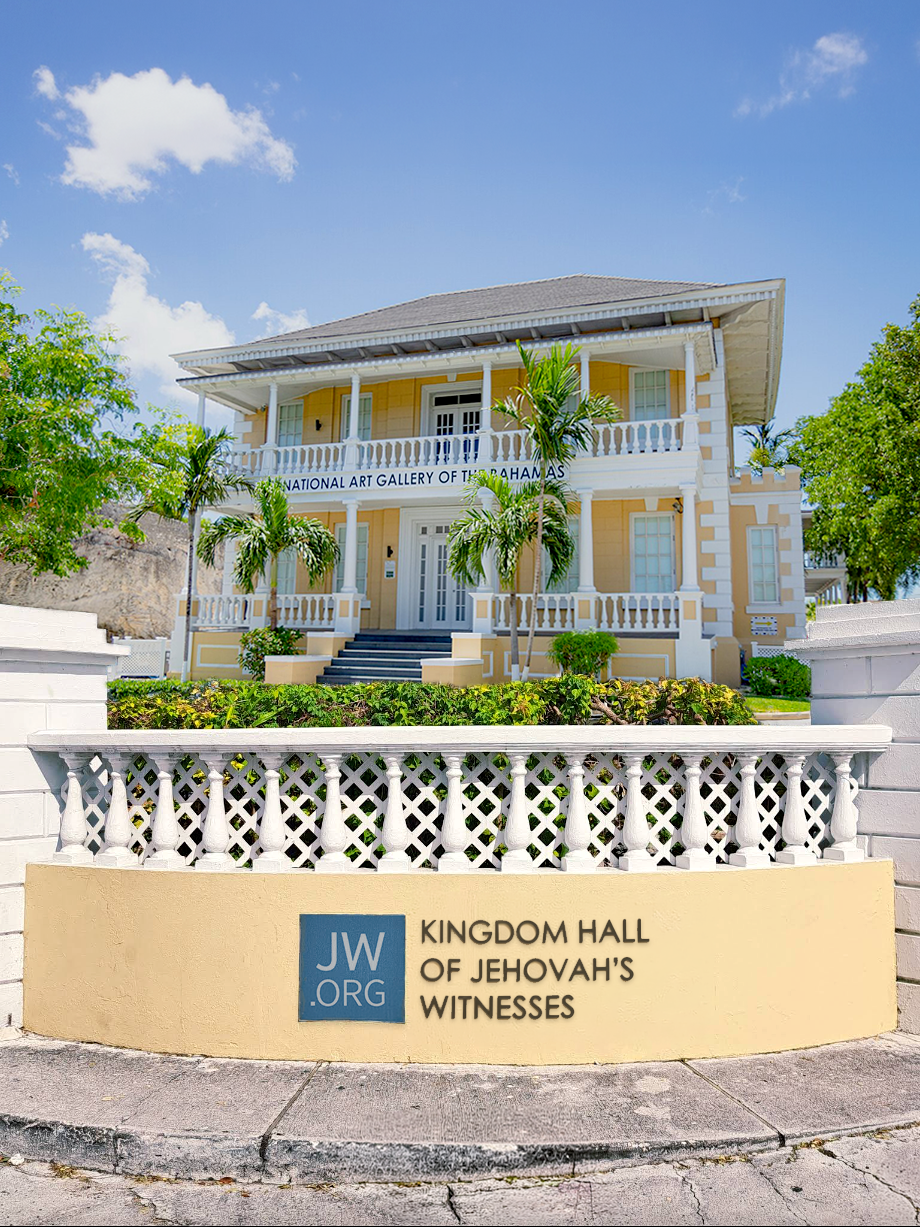
When future generations look back at the Minnis family and their impact on Bahamian art they will most likely start with the “Creation’s Grace” exhibition held at the National Art Gallery of The Bahamas (NAGB) in 2014. That future impact makes it more official Bahamian art history than art show.
However, it seems this was a family retrospective only in the sense that the family members included were all Jehovah’s Witnesses.
Out of all the things that have happened to me since I left the Witness faith, this is among the worst. It felt like this exhibition was a real attempt not only to write me out of the family story, but to wipe me out of existence.
To that Bahamian from the future, how will they even know that I was ever here?
I’m not saying that I should have had the same amount of wall space at the exhibition as my admittedly more prolific sisters — what I am saying is that I should have been there somewhere. To completely exclude me, a member of the Minnis family, from a Minnis family retrospective – when my paintings were already in the building and in the National Collection – demands some kind of explanation.
If there is no valid curatorial reason for leaving me out, then the NAGB was doing Jehovah’s Witness dirty work.
Yet, no explanation was in sight, not even a bio page, and for the cherry on top, there was never even a single attempt made by anyone involved in the exhibition to contact me. No phone calls, no text, no email. Nada. It’s as if the NAGB was trying to be more Jehovah than the Elders in a Witness congregation.
And that’s the whole problem — if there is no valid curatorial reason for leaving me out, then the NAGB was actually doing the Witness’ dirty work for them.
It’s downright shameful for a national institution to even appear to be punishing me for leaving the Jehovah’s Witness cult. And if it turns out that this is what they were actually doing; well then.
1.
In early 2025 I had the chance to speak and interview the three people in charge of the NAGB at the time of this exhibition:
- Stan Burnside – Chairman
- Amanda Coulson – Executive Director and Curator
- John Cox – Chief Curator
My goal in talking to them was to try to understand how a group of non-Witnesses could end up creating something that, even now, seems as Witness to the core as this. Did they justify my exclusion by some means that I did not see? Or didn’t want to see? In other words, were they right to leave me out?

Burnside distanced himself from the final exhibition product. According to his version of events he requested and expected to see an Eddie Minnis solo retrospective and was as surprised as anyone when the show was extended to the broader Minnis Family – and discovered even later that I was being excluded.
Nobody came back to me and said, instead of the retrospective, we’re gonna be doing this or that… Until it was almost hanging time. Really hard to change at that point.
He felt that he couldn’t force a course change so late in the process and his regret surfaces in his awkward mention of me in the “Creation’s Grace” introduction.
Cox began as the chief curator but soon left the NAGB to work for Bahamar. He doesn’t remember spending much time on the project compared to other exhibitions, like the Amos Ferguson retrospective, where he can recall his strategic decisions. He also put distance between himself and the final exhibition.
I just don’t want to say I had nothing to do with that because I feel that’s a cop-out because I was the head curator. I was leaving, but I don’t recall the point at which the decision was made to include the family.
Coulson confirmed that Cox was not that involved in preparing the exhibition and because he left the gallery in late 2013, she had to play double duty as both the executive director and the curator of the show.
While she is apologetic about my exclusion, as are the other two principals, and thinks that I am “owed a conversation” about what happened, she is at the same time proud of the finished product, especially given the time constraints, and defended her choices which included extending the scope to include the family and also leaving me out.
I’m not ashamed of the show. I don’t think it was a bad show. I think it held together. I think it did what it should do for kids coming into the NAGB, to learn about this artist and to learn about … his artistic legacy. And I think it did that.
Let’s have that conversation.
2.
Coulson repeatedly mentioned to me that one of the reasons why she felt justified in leaving me out was because I was absent from The Bahamas. During our interview she told me that:
There is something about being part of the community and digging in, right? Whether you chose not to dig in here for any reason, again, those are very sensitive issues and you might have all the reasons in the world, but you have been absent.
Her argument was that since I was not a “part of the community”, I had no right to be included. She put it this way:
You get to be included in something if you show up for something and you don’t just get to be included [just] because.
In our discussion Coulson articulated her idea of what a Bahamian artist is and should be. It involves the following three pillars:
- Physical presence.
- Documented record.
- An active ongoing practice, specifically painting.
As mentioned, I failed the first point because I lived abroad and rarely returned home. She claimed that there was nothing in the records available to her that documented anything that I had done, or at least nothing that she was able to find. The third strike against me was that I hadn’t maintained my painting practice in over a decade and this just did not compare to the rest of my family. She added:
I also try to research people and I didn’t see you as having such a deep practice.
There is truth in this. I haven’t been home in a long time. I live in Canada. My artistic practice has shrivelled since 2012.
First, though, a question: Why did I go away to begin with?
I left Nassau in 2004 to get a bachelor’s degree, and then went on to pursue a Master’s, which I completed in 2010.
Going abroad to get that paper is a rite of passage for many Bahamians. My father, Burnside and Cox all went abroad chasing degrees and their artistic practices were richer for it. Coulson herself did the same. Was I expected to be in two places at the same time?
Now, were “Creation’s Grace” staged today in 2026, I would likely agree with her views about my absence, but when work really began on that show in 2013, this argument was already a stretch.
Let me take a look at my own record for a moment.
We can start with my Masters degree in history. Far from neglecting my homeland, I wrote my thesis on – wait for it – the Fergusons of Farm Road, the groundbreaking Bahamian radio soap opera co-created by my aunt Jeanne Thompson and Jamaican writer Sonia Mills. The only such study ever done. It was only because of my research that actual audio of the show, thought lost forever, was found.
Earlier in 2010, I wrote a major critical essay and staged a debate with Dr. Nicolette Bethel on her “Day of Absence” concept — at the NAGB no less. This was an event that was moderated by the late great Jackson Burnside III.
I followed this up in 2011 with a play that I wrote, acted in and produced, called “The Cabinet,” directed by Ian Strachan. It was a political comedy described by poet Sonia Farmer as “our very own Bahamian “Animal Farm.”” It ran for 12 shows between various venues in Nassau and Freeport, one of which sold-out the main Dundas stage.


And then there is my poetry, some of which was published in Tongues of the Ocean in 2009, The Caribbean Writer in 2010 and Anthurium in 2011.
In 2012, for the lead-up to the 2015 Pan-Am games in Toronto, I represented the whole damn country by painting the Bahamian entry in the “Play me, I’m Yours” street piano installation.
The piano was placed in the absolute prime location of “Union friggin’ Station” – the second-busiest railway station in North America – for a few weeks. My piano was probably seen by millions, for at the time around “200,000 Torontonians and tourists pass[ed] by every day.”


For someone to say in 2014 that I was absent from the community or hadn’t contributed anything to the culture in a long time is baffling. How much more was I expected to do?
Yes, many of my achievements are not about painting, but why do they have to be? “Creation’s Grace” easily handled my father’s multimedia, both his Pot Luck cartoons and music were given space, even my sister Shan had a poem of hers included, which makes the case against my various projects very hard to maintain.
Coulson’s claim that she wasn’t able to find anything that I had done online or in print is very hard to believe. Mainly because my own websites, including one devoted to “The Cabinet” play, were all up at the time.
There is also the pesky fact that telephones, email and Facebook all existed in 2013. I was not that hard to reach. And given that the Bahamas piano was only a year old – and I had just represented the country internationally – it makes her argument seem petty.
Also, Coulson’s idea of “being here” is positively pre-internet. For example, in Jackson Burnside’s opening remarks at the “Day of Absence” debate in 2010 he said regarding Dr. Bethel and myself:
What is fascinating today is they could be anywhere and still be here, getting in the business of “Who we are and What we are all about.”
Up until I staged “the Cabinet,” my writing was so focused on the Bahamas that I regularly engaged other artists like Bethel and the late Burnside.
Yes, I wasn’t living in the Bahamas when the “Creation’s Grace” exhibition was being worked on, but with the list of work I had done from 2009 – 2012 to say that I had completely disappeared is not a credible argument and takes what-have-you-done-for-me-lately to an extreme.
Even if you buy that I was not in the country enough, or had not done enough art while earning degrees in the years leading up to “Creation’s Grace,” we need to think about the exhibit itself. Was this a showing of recent works or a retrospective? If it was about recent work alone then this thinking would have slightly more traction. But it wasn’t. This fact alone makes the whole where-have-you-been argument invalid.
Ultimately, the most compelling argument in favour of my contributions to the Bahamian community and presence within it comes from Coulson herself.

I found a “Teacher’s Packet” that was produced by the NAGB in 2016. It discussed my “Famous Faces” show in a condensed version of the “Bahamian Modernism” essay written by Dr. Erica James. It also includes my bio alongside other prominent Bahamian artists, from John Cox to Dorman Stubbs. According to the introduction by Coulson the purpose for producing this packet was:
to make current and future generations aware of some of The Bahamas’ foremost artists and art movements.
So according to Coulson – I am amongst The Bahamas’ “foremost artists” that she wanted “future generations to be aware of.”
This of course, begs the question – how can I be a foremost Bahamian artist that future generations should know about if I can’t be included in my own family’s retrospective?
The gods of irony demand that I further quote Coulson as she says:
“I have been both delighted and saddened to see the acclaim with which our talented compatriots are embraced overseas yet still struggle for recognition in our Bahamian backyard.”
It’s really something when you understand how and why that struggle for recognition happens.
3.
Both Coulson and my father defend my exclusion on the basis of theme. In a 2015 email my father told me that:
The main factor in your exclusion was that it was a Realism exhibition. Your paintings did not fit that category.
In the next sentence he added, “Another factor was your disassociation [from the Jehovah’s Witnesses],” but let’s set that smoking gun aside for now.
I asked Coulson about his thematic argument and she went further saying that the exhibition was really about Bahamian nostalgia and that this concept was not present in my work.
The concept for the show was kind of, like, this nostalgia, this capturing of the Bahamas a certain way, this seeing how people live.
So not only was the way I painted too far afield of the family, but apparently the content of my work was also not fitting the vibe.
If this logic actually held, my father’s early work, which was much more impressionistic, would not have been included either. But the show was a retrospective. The whole point was to show how his style changed over time. Just because he tightened his technique and headed towards greater realism was no reason to take out his wonderful early pieces.


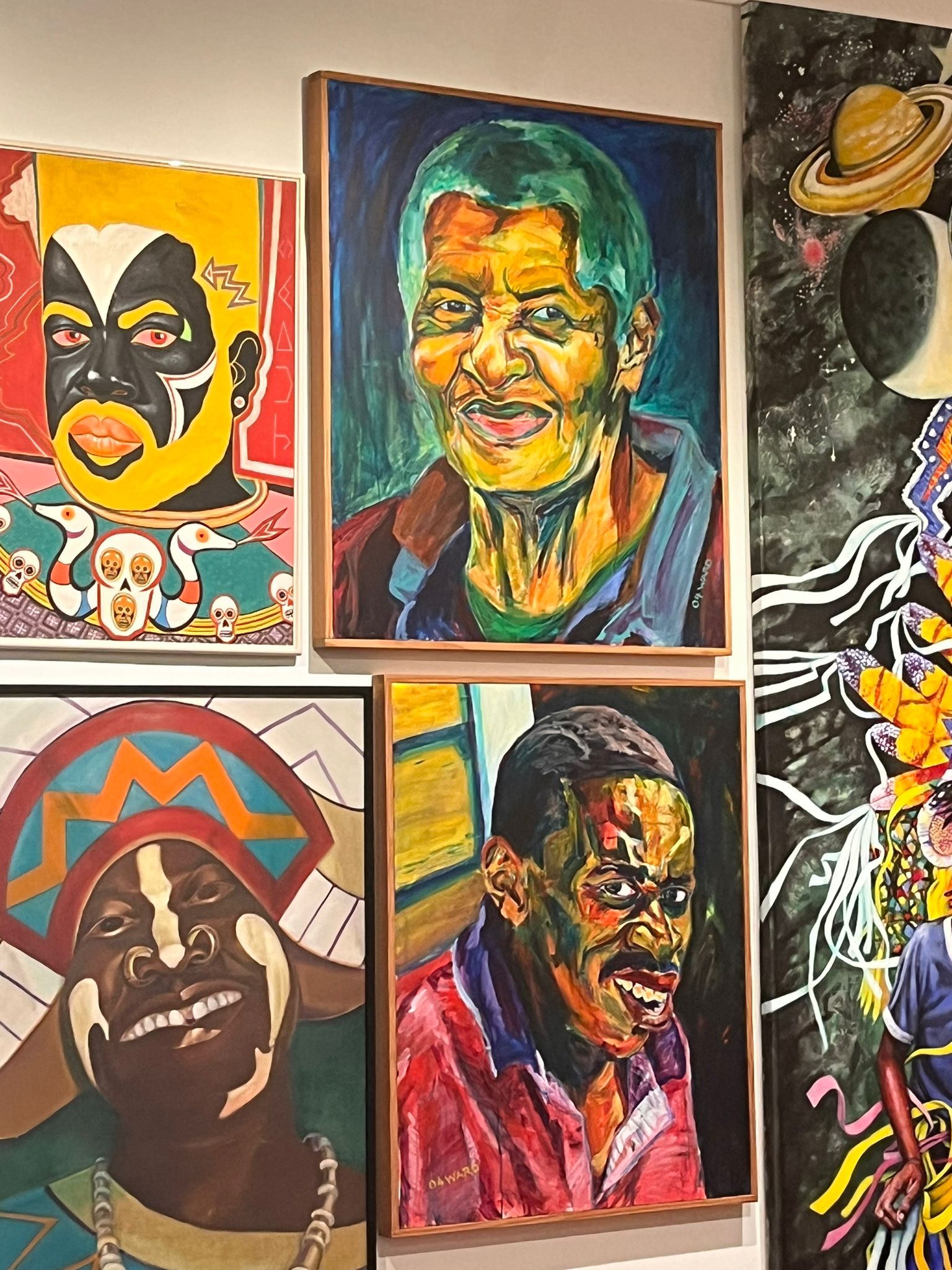
Similarly, my work is not all abstract expressionism. The pieces of mine that are in the National Collection are from the “Famous Faces of Nassau” show, a joint exhibition that I did with Jace McKinney in 2004. The show was all portraits that, due to the concept, needed to be recognizable. How can it be said that this work wasn’t some degree of realism?
In her essay on Bahamian Modernism, Dr. Erica James – former NAGB director, Coulson’s immediate predecessor and the curator who purchased my work for the National Collection – wrote about the “Famous Faces of Nassau,” saying:
McKinney and Minnis wanted to deconstruct notions of fame in the country and used the medium of portraiture to monumentalize both ‘official’ famous figures such as politicians, preachers etc., right along with ‘unofficial’ figures – beggars, prostitutes, street urchins, baseheads and others going through their individual struggles.


In other words, “Famous Faces” was doing exactly what Coulson celebrated in my family’s work:
These people and their dwellings are never frowned upon, rather they are given a dignity and grace that belies their often humble existences.
The theme angle is noticeably absent in Coulson’s arguments for including son-in-law Ritchie Eyma. She says that “Eyma’s approach is complementary but also noticeably different.” I find it curious that the same line of thought was not applied to me. My work is also “noticeably different” and shares a similar dark palette with Eyma. There are many other “complementary” elements to be found. If, in fact, you look for them.
You can draw a direct line between my “Famous Faces” show and the portrait commissions my sisters have done, or to my father’s many Pot Luck caricatures.
I find it odd that none of my sisters’ bust-style portraits, of which there are many, were exhibited – even as some of my father’s own portrait work made it in.


A cynic, such as myself, might even say that the exhibition was curated in a way that hides possible links between my work and that of my family.
One of those links is the various forms our art has taken. Like my father, I’ve worked in multiple forms. My acting and theatre work mirror his time as Samuel on the Fergusons of Farm Road — an aspect of his career that appears nowhere in Coulson’s essay or in the bio she wrote for him.
But go a layer deeper, past the portraits and to the intent behind them, and there is a direct connection between my art and my father’s early period, or as I have described it, his first phase. John Cox described it like this:
I kind of feel philosophically, Ward Minnis is more connected to the social realist in Eddie Minnis
For example, my satirical play “the Cabinet”, while very different from anything my father did, was, at its core, the spirit of Pot Luck manifested on stage. The “Famous faces” show, by placing the powerful next to every day street people shared a connection to my father’s first phase work by asking pointed questions about Bahamian society.
The social realism connection that we share is obscured by the retrospective’s obsession with his “gem-like canvases” at the expense of his over-the-hill paintings that show the full mess, the often vibrant dilapidation, of Bahamian life.
It is true that the idea of “Bahamian nostalgia” — an aching for an idealized and romanticized past — is absent from my work, but to be honest, it’s also absent from my father’s phase one work as well.
To force the full career arc of Eddie Minnis into the idea of Bahamian nostalgia is to reject not only all of the strands that would tie us together, but it also completely misses the point of his early work.
4.
The same misreading is seen everywhere in “Creation’s Grace”. In the essay that opens the catalogue, Coulson describes my father’s work by saying that “More often than not, these images are unpopulated.” She describes a concept – the landscape of the imagination – that she claims is defined by Eddie Minnis.
Generally the landscape of the imagination is unpopulated, there are no smoking Jitneys bumping down the potholed roads or groups of people gathering for conversation or altercation. You have, in fact, just imagined a painting by Mr. Eddie Minnis
While it is true that he did paint unpopulated landscapes, to claim that this defines his body of work is … a choice.
The retrospective itself is the proof. There are about as many pieces with people in them as there are ‘unpopulated’ ones.


In an essay by Nastassia Pratt, published in 2021 in Caribbean InTransit, titled “Architectural Translations in Bahamian Fine Art” she cites his “Hay Street Yard” painting by referring specifically to the people within it. While she describes it as a tourist-driven, commercially oriented view of ‘island living,’ her whole point is that the painting shows:
Black children playing in the yard, the washerwoman hanging clothes on the line and brightly-painted clapboard houses lifted up on concrete blocks in the dusty yard.
On the one hand, we have Coulson describing his work as mostly devoid of people, while on the other we have Pratt, referencing his work for the very things that are supposedly absent. Which is it?
One of his iconic canvases is “Balcony House”, the genesis of which was described in detail in the “Ting an’ Ting” documentary. This painting stands out to me for its strong figure work throughout the composition. There are nearly a dozen distinct figures in multiple groupings, any of which could have been expanded and enlarged into a painting by Nicole or Shan.
To have both of these canvases in the retrospective hanging alongside many more that show the daily lives of Bahamians, and then to describe his work as mainly “unpopulated” is to grossly misunderstand his body of work and, on a certain level, not even to see it.
While Pratt is correct to describe the commercial nature of his canvases, I believe that she too misses the point. It is a corrosive influence to be sure, but art and commercial interests have to co-exist. For Eddie Minnis, as a Black Bahamian man, the very act of surviving as an artist in that time and place, was itself a political statement whether his canvases were or not.

The community was his studio. He worked amongst the people, in the Bahamian sun, with random people standing over his shoulder offering unsolicited critiques in real time. This was a practice that required tremendous courage.
In “Ting an’ Ting,” Charlie Bahama spoke glowingly about his first exposure to Eddie Minnis – seeing him painting on the street on his way home from school, in the same spot, for weeks on end.
For my father, the fact that he was making it as an artist, and was visible in the community doing so, was a true middle finger to everyone who said he couldn’t do it.
The Bahamas had no framework to describe what he was doing, and in many ways, we still don’t.
Burnside picked up this theme in his introductory remarks – calling it a “Profile in Courage.” He spoke to me about my father’s career in reverent terms:
[Eddie] was such a fearless adventurer. … in those days, it was an impossible task for anyone to think that they could make a living from art. And for him to take that plunge … took a tremendous amount of his soul. … And what he did as a courageous artist is what all of the artists who came behind him stood on. He allowed them to stand on his shoulders and create … But he had a major, major part just by virtue of the sacrifice that he made.
The radical nature of his practice, and the courage required to live it, receives no coverage in Coulson’s catalogue essay and bio – although she does touch on it in her “Ting an’ Ting” interviews more than a decade later.
Coulson’s writings about Pot Luck also severely undersell and undercut the courage that was required to produce it. She writes:
Political cartoons such as these consequently played the very important role of the King’s jester: the only person allowed to poke holes using humour and wit, in the ruler’s facade without fear of reprisal.
The idea that he was “allowed” to produce Pot Luck by the good graces of the Pindling regime is laughable. “Ting an’ Ting” discussed several of his songs that were banned from ZNS, the lone government-controlled radio station at the time — this is the very definition of “reprisal.”
For example, when I staged “The Cabinet” in 2011, I was personally terrified of how the play, which essentially accused the sitting Prime Minister of treason, would be received. I can only imagine the boldness required to do the same during the PLP years. Speaking out and criticizing the powerful in The Bahamas invites risk, and Pot Luck skewered everyone, not just the ruling party. A fact that invalidates Coulson’s “court jester” framing. My father spoke about this himself when he wrote:
For it is only by being honest with ourselves, that we will be able to see what is wrong, bring it to the attention of the nation and correct it.
A jester simply entertains the court but Pot Luck’s original intention was not just to entertain, but to correct.
In short, Coulson did not ignore the radical side of Eddie Minnis. His cartoons are in the catalogue. His populated canvases were on the walls. His own words are reproduced in the very book she edited. All the pieces were there. She was either unable or unwilling to put them together.
5.
Coulson articulated a final argument for my exclusion, which essentially boils down to the question: who actually is a part of the Minnis family?
In the context of the “Creation’s Grace” retrospective she told me that “the show wasn’t about biology.” She continued:
The show was about your father’s impact on a community, and what his version of painting, what that engendered — who inherited that particular branch of painting.
She said that she could have followed this line of reasoning in “Creation’s Grace” and allowed other artists into the exhibition to show this connection. She added that this thread was better explored a few years later in March 2018 with the show “Traversing the Picturesque.”
And fair enough, “Creation’s Grace” could have been a different show and it certainly would have been had there been other artists included, but the only thing that we actually have is the exhibition that we got. So let us focus our attention there.
Take a moment to reflect on this idea that the “Creation’s Grace: Minnis Family Retrospective” — “wasn’t about biology.” It’s a stunning claim, because a family retrospective is by definition, at least partly, about biology. The word “family” is doing a good deal of the organizing work. It’s in the title. Nicole and Shan are there, not because their work is that similar to Eddie Minnis’, but because they are his daughters.
Coulson had to provide a curatorial argument for Ritchie Eyma’s inclusion in the exhibition – by saying that his approach is “complementary but noticeably different” – because he isn’t biological family. His inclusion needs an explanation, Nicole and Shan need none. Coulson asserts, for shifting reasons, that he has become “a part of the Minnis family and its artistic heritage.” In the catalogue it’s because he is Shan’s “soulmate” and on the NAGB website it’s because he has exhibited together with them since 2005.
Biology was the floor for the included artists — except, of course, when it came to me. As Eddie’s son, with work in the National Collection, I clearly met that simple biological requirement. Surely there was enough room on the walls for one canvas to represent my painting career and she could have written a line more expansive than the parenthetical, “also an artist and a writer,” that she put into my father’s bio.
I would instead argue that if I were included in the show it would have made the Minnis family seem even more outstanding as it demonstrates that all of Eddie’s children have the artistic impulse, whether directly influenced by him or not, a fact that is, in itself, remarkable.
Since Ritchie’s presence needs justification, especially in light of my exclusion, Coulson went further to defend her decision by defining what ‘family’ means. Regarding Ritchie specifically she says:
He’s there and he shows up and they are together and they talk about their work and they have an everyday intimate relationship that I think makes the family.
Her definition of family that includes shared daily life, intimacy and showing up sounds reasonable. But it quietly accepts the current shape of the Minnis family as normal, without ever asking why that shape exists.
The only reason that any of this is even a question is because I left the Jehovah’s Witnesses. The religion enforces mandatory shunning of apostates, and so I have been cut off from having a normal relationship with my immediate family.
For example, when I asked my father why he didn’t respect my wishes and remove me from “Ting an’ Ting,” he told me that “the family” had decided to keep me in the documentary. It’s a simple statement, but the meaning is clear. As far as he is concerned, I’m not family anymore.
Leaving the Jehovah’s Witnesses was the exit that closed every door. The arguments shift and contradict each other because none of them is the real argument. They’re all just different ways of arriving at the same conclusion.
What Coulson really means when she says “the show wasn’t about biology”, but can’t say out loud, is that the exhibition was about the approved family. The family that remained in good standing with the Jehovah’s Witnesses.
In the “Creation’s Grace” catalogue she wrote:
This exhibition aims to show how the artists have been inspired by one another and how, while focusing on different aspects of creation, they share in a common view of the world.
That “common view of the world” is the Jehovah’s Witness view of the world. Inclusion in the exhibition depended on being in good standing with the cult.
And then we find this, on the NAGB website, sitting in plain sight for over a decade — the real smoking gun.
All devout representatives of the Jehovah’s Witness Ministry, the family works tirelessly in the community and sees their artwork as a tribute to the glory of creation.
There it is. In plain English, and in Coulson’s own words, the actual criteria for inclusion in “Creation’s Grace”.
As such, no version of Ward Minnis could have been included in that retrospective — not the present one, not the absent one, not the painter, not the playwright, not the social critic, not the biological son.
And Coulson, at the head of a national institution, ran with it without asking why.
6.
A striking detail about the “Creation’s Grace” exhibition is that no one seems entirely pleased with it.
The man who requested it, Stan Burnside, basically said that what he got wasn’t what he asked for:
The nature of the exhibition changed from what I presented to her and she accepted, and what finally was presented.
And this despite Coulson telling me that she followed Stan’s mandate like a “good little soldier”.
So if the mandate was missed badly enough that the general in charge wasn’t happy with the final product, the question must be asked: who did it actually serve?
One of the most damning things about “Creation’s Grace” was that it was so familiar. Its expansion to include the whole family, for which Coulson receives credit, is something that had already happened nearly a decade before and was essentially just a continuation of the family custom.
The contours of the “Minnis family” are all there, with the wholesome imagery, the use of Ritchie Eyma to replace the apostate son, even ‘Bahamian nostalgia’ itself – these things did not originate with the NAGB, rather they are just ideas borrowed wholesale from what I have come to call “the Minnis Family brand.”
You can see this brand at work on the EddieMinnis.com collection of sites as my father has spread his patriarchy to cover the family, similar to the way that the large poinciana on the cover of the “Creation’s Grace” catalogue overwhelms and covers his painting and that of Nicole, Shan and Ritchie.
It is both umbrella and smothering blanket. The domains of RitchieEyma.com, NicoleMinnis.com and RoshanneMinnis.com are simply satellites of the main store front, of Eddie Minnis.

It is hard to see how this show would have been any different had it been directly curated by my father. At the very least, he seems to have had an undue influence on the final product. Burnside himself said regarding the exhibition:
Some, or the big bulk of the responsibility has to be on your father’s shoulders. Because he had the control over what could be done and not done.
But if this retrospective was not the place and not the time to scrutinize the Minnis brand then I’m not sure what the point of all of this was. The end goal was predetermined, possibly by Eddie Minnis himself, and the rationale for getting there was just made up along the way. The NAGB just provided institutional cover for what was essentially a glamour project.
Keeping me out, of course, made everything easier. No difficult questions needed to be asked; they didn’t have to address the impact of the Jehovah’s Witnesses on their art, on their lives or on our community and they just got on with the business of blowing smoke.
The most celebrated critic of Bahamian society got the most uncritical exhibition imaginable.
7.
“I come to collect. I come to collect. I come to collect.”
One thing that Coulson said to me many times, and in different ways, was this:
I am not particularly wanting to be put in the middle of a feud or become a caricature to throw mud at.
Unfortunately, that is not how this works.
First, sides were taken by cutting me out. Second, no one gets to be the head of a national institution and then have their decisions and writings exempt from criticism. She is the person most responsible for the “Creation’s Grace” exhibition and she is the only one who defends the final product.
I said what I said.
Stan Burnside and John Cox were not as involved in the exhibition but they also share blame. Burnside said that he realized late in the process that errors had been made and added me to his introduction. But to this point has done nothing to rectify the errors and has said nothing directly about it. Cox admitted that he could have said something once he saw the final exhibition, but he also did nothing and has said nothing about it. Due to this silence and inaction, both of them bear responsibility.
They aren’t the only ones either. My own extended family said nothing. My aunts including Jeanne Thompson, who spoke at the opening, Jessica Minnis and Heather Thompson, and cousins like the late great Dr. Gail Saunders, whose essay appears in the catalogue and Dr. Ian Bethel-Bennett, who wrote about the exhibition in the Nassau Guardian, they didn’t just turn a blind eye — they celebrated the exhibition.
If anyone was in a position to know what was wrong with “Creation’s Grace” it would have been them.
With all of the silence from the principals and my extended family’s approval I can’t really fault the wider community for following suit and also staying quiet.
What does it say though, about the Bahamian art community, that they looked at an act of erasure in their leading national institution and either didn’t see it, or collectively decided not to?
“Pay me oh. Pay me what you owe me.”
And here we are, more than a decade later, while the compound interest on this scandal continues to accrue. I’m not trying to imply that I am some Picasso Brent Malone figure — and I don’t have to be — I’m saying that I had done more than enough in my career to be included with my family in that retrospective.
I am saying that by following Minnis family custom, Coulson and the NAGB became the enforcers of Jehovah’s Witness rules.
By following Minnis family custom, the NAGB became the enforcer of Jehovah’s Witness rules.
Blinded by my father’s fame, a national institution put on a private exhibition that served no one but the Witness members of my family and rewarded them for being good cult members, and in the process, further punished me for freeing myself from their cult.
And this brings us to the true masterpiece that lies at the dark heart of this retrospective.
Beyond being an epic failure on every conceivable curatorial level, this exhibition tries to hide not one, but two erasures.
“Creation’s Grace” presents itself as a retrospective — a full accounting of an artist’s development over time. But what it actually shows is phase two Eddie, the post-conversion Jehovah’s Witness, looking back over phase one and reinterpreting everything through a Witness lens. The early street historian paintings, the music and even Pot Luck are there, but they’re framed as the beginning of his journey toward maturity – Witness maturity – as if his early work was somehow defiling.
It looks like an Eddie Minnis retrospective. It has his name on it, his paintings and chosen family around him. But the driving force of his best work – his willingness to be honest with Bahamian society for its betterment – is completely absent. In the 1972 preface to “the Best of Pot Luck,” he laid out what was essentially his early mission statement:
I feel that, as a Bahamian, I have the right — in fact I believe that it goes deeper than that — I have a duty to point out anything that seems wrong to me in my society.
This was the Eddie Minnis who changed Bahamian culture. Far from being “mere decoration” — he is essential. This is the man who was completely erased from “Creation’s Grace”.
My work and career lay closest to phase one Eddie Minnis, and were thrown out along with the best parts and intention behind his own early work. Early father and son were both surgically removed. The operation was a success. The patient died. And is nowhere to be seen.
The person we want to celebrate is not Eddie Minnis the congregation elder, or Eddie Minnis the Jehovah’s Witness — it’s Eddie the heathen, Eddie Minnis the rebel. He didn’t begin painting to glorify God. He even said himself that “It was because of my painting that I became a [Witness].” He was not religious or even spiritual when he started his art career. This was a later, second phase development, now superimposed on top of his original motivation.
Future generations of Bahamian artists and scholars who want to understand where their tradition came from, what Eddie Minnis actually meant and what he stood for — they will go to “Creation’s Grace” because it’s the official record. It’s what the NAGB produced. It will be cited, referenced, taught.
And it is wrong.
Deliberately, structurally, hilariously wrong. It’s a hollowed out account of his work and what motivated him.
“Creation’s Grace” isn’t just a disservice to him. It’s a disservice to every Bahamian who looks at that exhibition and tries to understand Eddie Minnis.
Everyone protected the Jehovah’s Witness he became and in so doing betrayed the man he was.
What can be done about this now?
Dear NAGB and new director Mrs. Maelynn Ford — The “Creation’s Grace” exhibition is still on your website without correction and its catalogue is still being sold in its original form. Let’s start there.
You owe me.
You owe us all.
Sincerely.
Coming up next: The final skeleton. It's titled "Breaking the Myth of the Minnis family"