The inquisition is here;
the firing squad
with the loaded guns.
Gunfight at the corral.
But it ain’t OK.
Six a them to me one.
This ain’t a fair fight.
I need Jesus
and a miracle.

Remember the Alamo
and the bitches of Salem.
Same in difference.
These hired guns tracked me down.
Big reward for my head.
Dead or alive.
Depending if you believe the posters
or the gossip.

These hombres was my brothers.
Now I stare back at ‘em.
They don’t remember me.
How we used to sit
round mama’s table and talk trivia.
Then they said they loved me.
Money makes men feign amnesia
and tell you they can help.
Part Two
The sun goes behind a cloud. High noon. The moment of truth. Before the first sweat bead drops I fill the bastards with lead. Heavy shit. They stagger back. I see the blank look in they eye.
In all of them guns they only ever had one bullet. A silver one. Big hole in my chest now sucking on my blood. Hole was there before the first shot went off. Foregone conclusion. They don’t have to be right to kill me dead.
Poetry is the history of the human heart. Billy Collins
Leaving the Jehovah’s Witness religion was a very intense period for me. There was such a potent cocktail of conflicting emotions coursing through my soul: betrayal and guilt, happiness and sorrow, and feeling everything at once and all the time.
During this period I wrote a lot of poetry as an outlet and a way to cope with the stress. It felt to me that poetry was the only thing that came out whenever I tried to write. It was my self-help and comfort.
For inclusion in this project I have selected ten poems that I wrote between 2003 and 2009. This period coincides with my awakening while within the Witnesses, my journey out of the religion and the immediate aftermath. Some of these pieces have been previously published, but here alongside the seven skeletons they are now, for the first time, presented in the context in which they were written. I feel that this contextual shift makes them all hit different.
I have, for the most part, resisted the urge to change them. I will admit though that there have been some light edits, mainly changing line breaks and enhancing readability.
From now until the end of this project I will provide a poem or two that fits alongside the week’s essay.
As I try to explain in the essays, on an intellectual level, what it meant for me to leave a cult like the Jehovah’s Witnesses, hopefully these poems provide some insight into what that felt like.
You can be prepared for something but that does not make the pain of it any less. Sarah Kendzior
I’m not calling Jehovah’s Witnesses a cult for the shock value. It’s just that the popular idea of what a cult is, and a huge chunk of the negative vibes that come along with that, is the best way to describe them.
I could go about proving they’re a cult a bunch of different ways. I could go the academic route and talk about the BITE model and discuss high-control religions who like to make end-of-the-world prophecies. I could discuss totalitarianism and how that manifests in religious structures. I could cite experts and other former members and really get into the nitty gritty and get all technical and jargony. But I won’t do any of that.
I’m just going to tell you what happened to me.
1.
The life of a Jehovah’s Witness begins only after they get baptized. In the “Ting an’ Ting” documentary, my sister Nicole says that she got baptized when she was 15. Totally her decision, she says.
I got baptized when I was twelve.
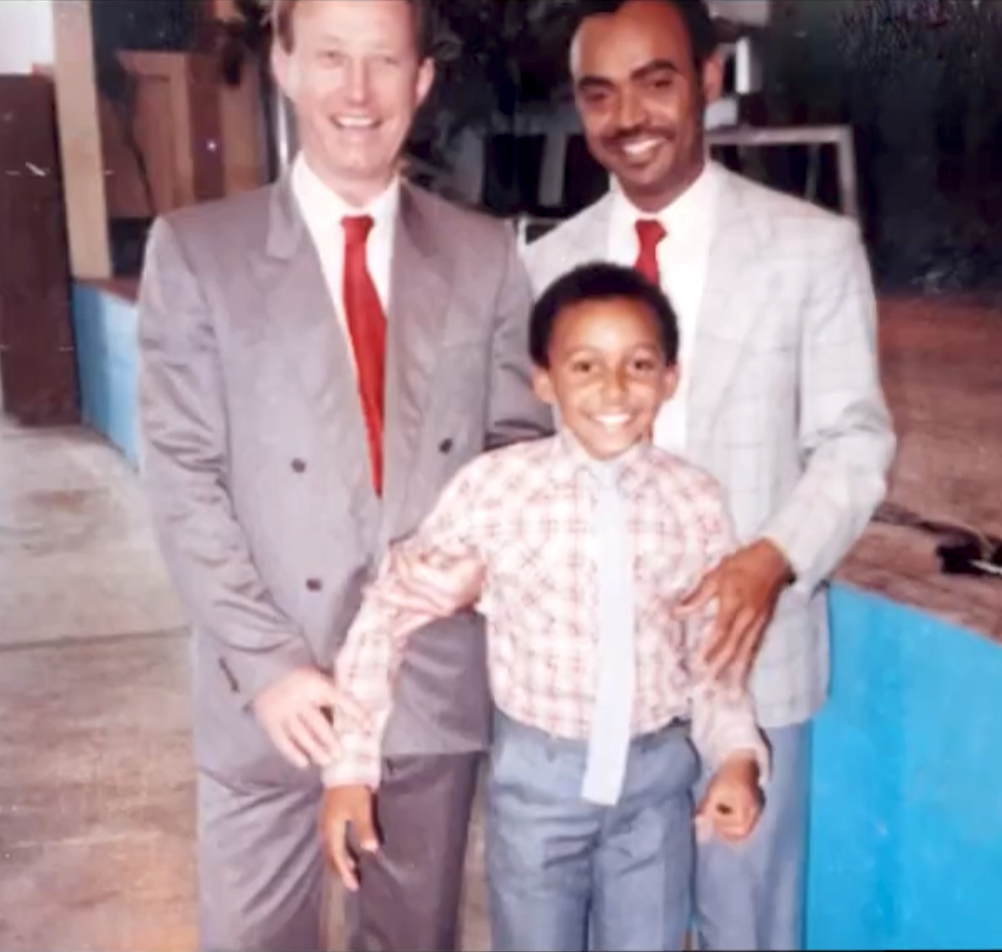
Photo from the day I was baptized. My father is on the right, I’m in the middle. I can’t remember who the man on the left is, but he probably gave the ‘Baptismal talk’.
This is a big deal because before you get baptized, you’re not a real Jehovah’s Witness. You’re not even a member. You’re just affiliated.
For one thing, baptism makes you eligible for a lot of Witness perks. For example, my sisters could become what they call “Pioneers” — back then that was someone who put in a thousand hours a year evangelizing — and eventually I did that too.
As a male though, I had access to more perks than they did. I got to carry the microphone in the Witness meetings, play the songs from the cassettes to start and end the services. I was even able to say prayers. Eventually, I took fuller advantage of all that maleness and became a “Ministerial Servant,” which was a crucial step up the ladder with the next rung being Elder.
What I didn’t think about at the time — and how could I, since I was only twelve —was that getting baptized also gave the Witnesses the power to kick me out.
Getting kicked out of the Witness religion was called “disfellowshipping”. It happens via an announcement made near the end of one of their meetings. A somber looking man would go up to the podium and say “so-and-so has been disfellowshipped” and just take all the air out of the room.
That phrase, as simple as it sounds, has crazy power. I remember a time when I was talking and laughing with someone before a meeting started – then that announcement happened for them – and when the meeting was finished I wouldn’t talk to them again. In fact, no one would. We all barely even made eye contact.
The not-talking part continued outside the Kingdom Hall too. Word would spread fast to all the Witnesses in Nassau and the disfellowshipped person would go from having a whole bunch of Witness friends to none at all.
Jehovah’s Witnesses practice shunning of former members, and disfellowshipping makes someone a former member. Witness teachings even tell parents, and siblings not to talk to their disfellowshipped family member. It’s as if the announcement killed the person on the spot. If the person grovels to the Elders — and grovels for at least a year — they may be let back into the flock but that reunion comes only after they had walked in the wilderness alone for, what to them, would have felt like an eternity.
2.
The most popular reason why people get disfellowshipped is probably for sex. Having an affair with the wrong person, like an unbeliever, or someone you’re not married to, or both. Being gay. You can even get disfellowshipped for smoking.
I got disfellowshipped because I stopped believing.
Before my crisis of conscience, I was one of the Witness’ rising stars. My dream was to go off to one of their missionary schools for single men. I was so serious I took a month off work with no pay to go convert people on another island. I was such a true true believer that at one point I didn’t think my dad was Witness enough.
Because I pushed the limits though, I started to see the gaps. The Watchtower said that if I did everything they told me to that I would be happy. I found out two things: it wasn’t humanly possible to do everything they demanded and no matter how much I did, I was never any happier. In fact, it was usually the opposite. The more I did the more useless and miserable I felt. I found out that the “truth” was the furthest thing from that and I reached for the exit.
I knew though that leaving would mean death for me. I knew that once they read that announcement I would be cut off from friends, family; my parents, my sisters. I knew that I might never talk to any of them again and I would lose the only life that I had ever known.
Many Witnesses come to the same conclusions that I did but not everyone is prepared to make that total sacrifice. A lot of people just fade. They quiet quit. They knock on less doors. They lead a double life. I’ve talked to a few of these people over the years – they reach out in secret as if we live in Cold War era Russia and they’re avoiding the KGB. As long as they don’t get caught, the theory goes, they get to keep their family and friends and don’t become total outcasts. And believe me, in the Witness world, the Elders are the KGB.
I knew that leaving would mean death for me. I knew that once they read that announcement I would be cut off from friends, family; my parents, my sisters.
I never had the ability to lead a double life though, I’m just not cut out for that. It was always all-or-nothing for me. So when the elders came looking for me I was ready. There was one time I had five of them to me one and I shot them down with their own Bible. That’s when they knew I was dangerous. That’s when they knew they had to get rid of me.
When I was finished standing up to them I went home, sat down, and cried.
I knew what was going to happen to me in theory, but I had no idea what it was really going to be like. The announcement was coming, but it was coming for me this time.
Once it came, I knew that in a very real sense, I would be no more.
3.
I had to go down this road to find the absolute truth about what Jehovah’s Witnesses believe. And it has nothing to do with the Bible or morality or even God. When you boil it all down, Jehovah’s Witnesses have to believe whatever is currently printed in the Watchtower magazine.
If the Watchtower tells my dad, my mother, my sisters not to speak or have anything to do with their son, their brother who is disfellowshipped, then by damn, that is what they are going to do.
Coming up next: “My Life as a Ghost” — Leaving the Witnesses brings heavy, heavy consequences ... and a whole new life. I’ll discuss my journey and where my family and I are at after 20 years of shunning.
Painting is just another way of keeping a diary. Pablo Picasso
It’s been 12 years since I finished a painting.
When you haven’t done something you love for that long there have to be strategies that you use to keep it that way. For me, these strategies existed in the form of excuses.
My favourite excuse is that painting requires so much more space than my writing. There is truth in this on multiple levels of what you would even call ‘space’.
When I’m talking about space in terms of time, I find that can block off an hour for writing and get something done, while an hour is hardly enough time for me to even set up for a painting session. Working full-time and having kids makes it so that my time is at a premium and I have told myself that the afternoon I would need for a painting session just isn’t logistically possible.
Complaining about set up time would also lead me to another definition of ‘space.’ Everything in the apartments and homes where I have lived has, of necessity, been multipurpose. I don’t have a studio and therefore don’t have a dedicated space to work.
Beyond the chore of setting up some corner of my home for a painting session I would then bemoan the lack of distance I was able to get from the canvas. In the classrooms of the College of the Bahamas (COB) where I really fell into my work, most of the time I spent painting was actually spent a few meters away, on the other end of the room, just staring at what I had done, trying to intuit what I needed to do next.
But likely the space that I really needed was mental. My art practice carries so much family baggage that once I lost momentum each paintbrush began to weigh a thousand pounds. In the end the internal voices and self-sabotage were too much.
And so a decade passed by.
1.
I have been thinking about a version of this project for a very long time and no matter which way I turned it over in my mind, I felt that to make the kind of statement that I wanted, that the subject matter demanded, I had to have a painting component to go along with it. It was the only way.
The old excuses were still there, but this time, out of desperation, I tried something new. Following the lead of a good friend I went digital.
Using digital tools eliminated a lot of my excuses about space. I no longer needed set up or even to clean up afterwards. My canvas was the same screen I peered into daily.
With those obstacles cleared I made time in my schedule and found that I was able to make notable progress on a piece in the same time constraints that I had with writing.
In terms of mental space – this project was in many ways the thing that stood in my way all along. Looking back now, I believe it was what I needed to get out of my system so I could move on.
As I worked, I became more free, more animated. The digital paintbrush became lighter as the baggage began to fall away. I began to hear my voice again over all the old background radiation.
This is not to say that I am cured, that backsliding into doubt for another ten years isn’t possible. That possibility is always there, lurking.
I only know that today I did what needed to be done.
2.
I am committed to have a painting go along with every major post in this limited series. That could either be an earlier work of mine, if it fits with an episode, or a new work that pulls directly from ideas, phrases or themes in the piece.
The work that I have created for this project is essentially a continuation of visual ideas that I had started when I was studying art at COB in 2003. Back then I exhibited this work at the “Colour of Harmony” show. I called this series “Inner Journey.” Any earlier work that is displayed in this project comes from that series.
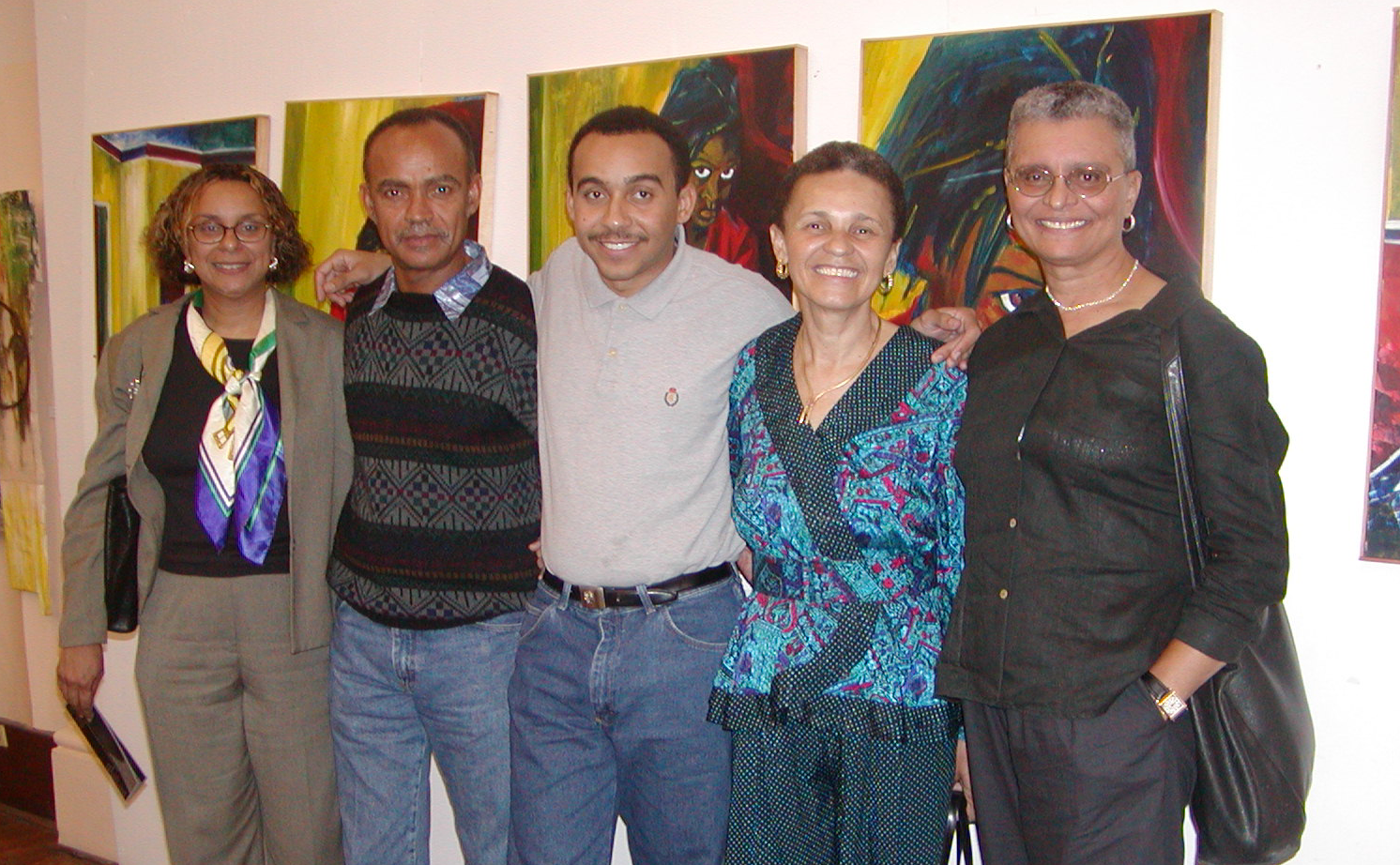
At the Colour of Harmony COB art show 2003 with my family. From left to right Heather Thompson, Eddie Minnis, Ward Minnis, Sherry Minnis and Jeanne Thompson. The Thompsons are not Witnesses.
At the time, I was still nominally one of Jehovah’s Witnesses, but I was well on my way out. While the series was my way of working through my doubts when it felt as if my world and my head were imploding, it was also a last attempt to show, to explain to my family what I was going through.
I was hoping that they would see what I was trying to say, but when I asked what they thought of the dark and depressing images I had created, they claimed to see nothing unusual.
I think the most important contribution [Eddie Minnis] has made to culture in this country is in the way he has lived his life. Stan Burnside
I was one of them.
I was a Jehovah’s Witness yes, but I was even more than that. I was what you would call a true true believer. To convert people to this religion I learned to speak fluent Haitian, I even did missionary work in the Abacos and Great Harbour Cay. Maybe I knocked on your door one Saturday morning with a broad smile holding a Watchtower magazine in my hand asking you about something deep, like ‘why do people die?’
Maybe you slammed the door in my face.
It’s not like I can blame you. I realize now that Saturday mornings are not the time and your front porch is not the place for those kinds of conversations. If that was me back then, I sincerely apologize. You have to understand that, at the time, that was all I knew. I was probably out there every week, barring sickness, since I could fit into a stroller.
I’m not the only one either. My whole family is so deeply steeped in this religion there isn’t a single part of us that isn’t stained.
The Minnis family as Jehovah’s Witnesses – circa 1990 at our home on the Current Ridge, Eleuthera. From left to right: Nicole, Sherry, Ward (me), Eddie, Shan.
As with most things in our family, it started with Dad. He’s the only one of us with a real conversion story. If you watched the “Ting an’ Ting” documentary about him, you heard him talk about how his yearning for God started. One day while he was out painting and listening to the radio it struck him that there was so much beauty in front of him and on his canvas but so much ugly on the news. His desire to reconcile the two realities led him to the Witnesses, and they helped him understand the Bible for the first time.
This answered his burning questions, something that he says he didn’t get from the Anglican Church that he grew up in. Everything began to fit for him. My Mom soon joined him in his Bible studies and they were baptized into the religion in 1974 and we, the children, naturally followed along.
1.
When he became a Witness, Eddie Minnis – my father, was already a Bahamian icon and fast approaching the apex of his powers. He was a firmly established artist, having painted all over Nassau in his trademarked cherry red Volkswagen van. The new Prime Minister, Lynden Pindling, was attending his exhibitions and even buying pieces.
The daily editorial cartoon was a concept that he imported from abroad and made wholly Bahamian. He called his creation “Pot Luck” and it ran in the Nassau Guardian newspaper. It had become so popular that, in a few short years, it was driving sales of the paper.
Eddie Minnis painting in the community before he became a Jehovah’s Witness.
He was also playing the lead character in “The Fergusons of Farm Road” – only the most popular Bahamian soap opera ever – which at the time, was still on ZNS radio.
He used the popularity of the Fergusons to launch, what was to pretty much everyone, a very unlikely music career. His first hit “Miss Lye,” performed by Kenny and the Beach Boys, was a song about the villain and the most popular character from the show.
He parlayed that success into a working partnership with Ronnie Butler, the biggest, baddest musician in the country and they had just released the hit “Our Love Is Gonna Make It” – with Ronnie on vocals in 1973.
To an outside observer it appeared that my father had the Midas touch and he probably had more power and influence than anyone in the country save the new PM. But as someone described by those who knew him as neither religious nor spiritual, he seemed the person least likely to have a religious epiphany much less undergo a radical conversion.
But he did.
What did he see in the Jehovah’s Witnesses that would make him trade in his dashiki for a suit and tie and go out regularly in the hot sun hawking Watchtowers?
He thought that he had found the “truth”.
Now, Witness beliefs are their own separate rabbit hole, but to get a basic grasp of the religion, there are only a few things that you have to know.
1.Jehovah’s Witnesses really do call their religion the “truth” and believe that they are God’s chosen people. They believe that their interpretation of the Bible comes straight from God through the Witness higher-ups. While this isn’t that much different than what most religions say, Witnesses take it very seriously. They are the one true religion and everyone else is wrong.
2. The end of the world is always just around the corner and when all is said and done there will only be Jehovah’s Witnesses left. This is because on judgment day God is going to kill everyone who isn’t a Witness.
3. Witnesses knock on your door because they don’t want God to kill you. Your only chance to survive Armageddon is to become a Jehovah’s Witness. So every time you slam that door in their face remember that you are giving God one more reason to kill you.
4. The prize Witnesses promise for surviving Armageddon is life in a Paradise Earth.
Witness literature like the Watchtower and the Awake! and their countless books are jam-packed with pictures of Paradise. They show you little children playing with lions, lions playing with lambs, people of all stripes, colours and ethnicities mingling in peace and harmony.
A Jehovah’s Witness rendition of the paradise earth.
Paradise would be a world with only Jehovah’s Witnesses, and as such it would also be a planet with no war, no sickness and even no death. Long dead loved ones who didn’t have a chance to be converted to the Witness faith would come back to life and then have the chance to learn their theology alongside Biblical legends like Moses and Enoch.
Make it there, and you would live forever.
2.
The early 1970s were no ordinary time in the history of the Witnesses. The organization was seeing huge year-over-year increases in membership as followers were putting in maximum effort to convert as many people as possible. There are stories from around the world of people putting off surgeries, dropping out of school, selling their homes and putting everything in their life on hold. This was because Jehovah’s Witnesses believed and actively taught people that the end of the world was coming in 1975.
So not only had my father found the “truth”, but he had found it just in the nick of time!
Jehovah’s Witnesses believed and taught that the end of the world was coming in 1975.
This truth did not come cheap though. He had to give up a lot to embrace this new faith. If you watched the documentary you might think that the only thing he had to do was cut off his beard. It was so much more than that.
He started knocking on doors, which must have been a humiliating process for him. He wasn’t an anonymous figure in Nassau anymore, he was a celebrity. He had overcome so much scorn for painting on the side of the road and now he had to do it all over again for passing out Watchtower literature. I can imagine people excited to find Eddie Minnis at their doorstep souring by the minute when they realized what he was really there for.
In addition to all the preaching, he had to go to 5 hour-long meetings a week at the Kingdom Hall. He tried to convert his friends and relatives to his new faith and pushed many of them away. He had to give up celebrating Christmas, Easter, birthdays, and even Mother’s Day. And this was only the beginning, because his painting and his art gradually transformed from his passion into a means to an end, as in his words, he spent “most of his time” in the Witness preaching work.
You may be thinking though that we’re now in the year two thousand and twenty-five. 1975 came and went and this wicked old world didn’t go nowhere. Armageddon didn’t happen, yet Eddie Minnis remained a Witness. For another 50 years.
To understand the reason he stayed in the religion long past that great disappointment brings me to the last thing that you have to know about Jehovah’s Witnesses:
Coming up next: “Using the ‘C’ Word Responsibly” — Yeah, damn right I called them a cult. Next week, I'm going to unpack some deep personal trauma to show you why.
A movie just came out about my family and I got about a billion bones to pick with it.
My sisters are in it, my mother is in it. Hell, I’m even in it. But it’s really about my dad, the legendary Eddie Minnis. Yes, THE Eddie Minnis. The iconic Bahamian fine artist, cartoonist, singer and songwriter. It’s called “Ting an’ Ting”, and it’s directed by Kevin Taylor, executive produced by Edgar Seligman. You can Google them.
It premiered at the Bahamas International Film Festival (BIFF) over the 2024 Christmas holidays and to put it bluntly, in its current form, I want nothing to do with it.
I dead serious.
I’ve asked the director, my dad, and the executive producer of the thing to cut me out of it and they have all, so far, refused. “The movie finish” is basically their line.
Last week, I even dropped a press release about why I want to be taken out of this film. But a press release has to be short. It can’t possibly hope to contain all the backstory, all the nuance, all the tea that I need to spill to make you understand where I’m coming from.
You ever been quiet about something so long that when you finally get tired and fed up and have to start saying what’s on your chest that you can’t stop? Well, that’s where I am right now. I’m standing in front of this massive walk-in closet full of rotten old skeletons and wondering which one I need to air out first.
Let me start with this: There was another version of this movie that I wish you could see, let’s call it the “Director’s Cut.” When Kevin came to me in 2023 about this project I asked him if he was sure he wanted me of all people to be in this movie. I am Ward Minnis, Eddie Minnis’ son, but I am also the black sheep of the family. Don’t believe me? Go to his website and try to find me. Go on, I’ll wait.
I’m standing in front of this walk-in closet full of rotten old skeletons and wondering which one I need to air out first.
“Eddie Minnis and Family” has come to mean “Eddie Minnis and daughters and even son-in-law” – this might be the first time you even heard that he has a son. It might surprise you even more to know that I also paint. That I am also a writer, an actor, and a bunch of other artistic things; but we’ll get to that later.
So why am I on the outs with my people? What did I do that was so evil that I needed to be scrubbed out of the Minnis family record on the website, then kept against my will in the documentary? Well, that’s the thing that’s in the Director’s Cut that I wish you could see. That version goes into their religion, Jehovah’s Witnesses, and the fact that he raised all of his children, including me, in that religion. And then, when I turned twenty-five, I left.
Yes, I left the Jehovah’s Witnesses and I been catching hell for it ever since.
That version of the documentary isn’t perfect either but at least it was honest. This one, the one that you might have seen at BIFF, is by contrast a joke. I’m still there talking about my ‘artist’s journey’ and of course the movie is still about Dad and you get a bunch of that. But, for me, the thing that mattered most to me, my pain and the cross that I bear daily got reduced to a single title card.
Now you might say, why did you want to be in this movie anyway? You should have said no from the beginning. And you know what? You are absolutely right. I should have listened to you and I should have listened to my wife who told me the exact same thing from jump street. But I hard-headed and I didn’t listen and if I didn’t see that Director’s Cut I would say that I deserved what I got.
But, I did see it. And it was good. Then everything that made it good was ripped out of it. Now its only purpose is to be a vehicle to glorify my old man.
My father is in that phase of his career, let’s call it the twilight, where people want to give him his flowers while he’s alive. The “Ting an’ Ting” movie went from being a thoughtful consideration of him and his life into what these things always end up as – an extended chorus of “How Great Thou Art“. And good for him.
That isn’t the reason that I want out though, because don’t get me wrong, he is great and legendary and all those other adjectives too.
The main reason I want out is because the released version makes Jehovah’s Witnesses seem like a normal religion.
And I am here to tell you why that just ain’t so.
The bottom line: If you want a happier family, bring those skeletons out of the closet. Bruce Feiler
Here’s the deal: I’m not going to do this all in one go. I’m going to break it up into episodes. I’ve done picked out the seven juiciest most rancid skeletons in that walk-in closet and every week from now till I’m done I’m going to dissect a different one, bone by bone, and piece by piece and give you the full report.
I’m going to give you what you haven’t gotten from the “Ting an’ Ting” documentary or any other thing you have read or seen about my family, which is a full examination of them as Jehovah’s Witnesses as only an insider outsider like me could do.
To do this, I’m going to have to go deep and of course this involves me telling a lot of my own story too. We’ll be talking about art, some history, a bunch of cultural criticism and a whole boatload of tea.
I’m going to give you a full examination of my family as Jehovah’s Witnesses as only an insider outsider like me could do.
It’s about the Minnis family but trust that a lot of people you know will be catching strays or direct shots too. This is our family story but it is also a deeply Bahamian story. This is where we start, but I think you’ll be surprised where we going to end up.
[September 12, 2025] – Ward Minnis, son of famous artist, cartoonist, singer and song-writer Eddie Minnis, has formally requested to be removed from the “Ting an’ Ting” documentary film about his father. Minnis’ desire to be removed from the film is caused by editorial changes that he says violate his original agreement with the filmmakers.
Despite initial assurances from the producer that his request would be considered, no action has been taken in over nine months to address his concerns. In response he has prepared an expansive artistic experience to tell his side of the story that is set to begin Tuesday, September 16th.
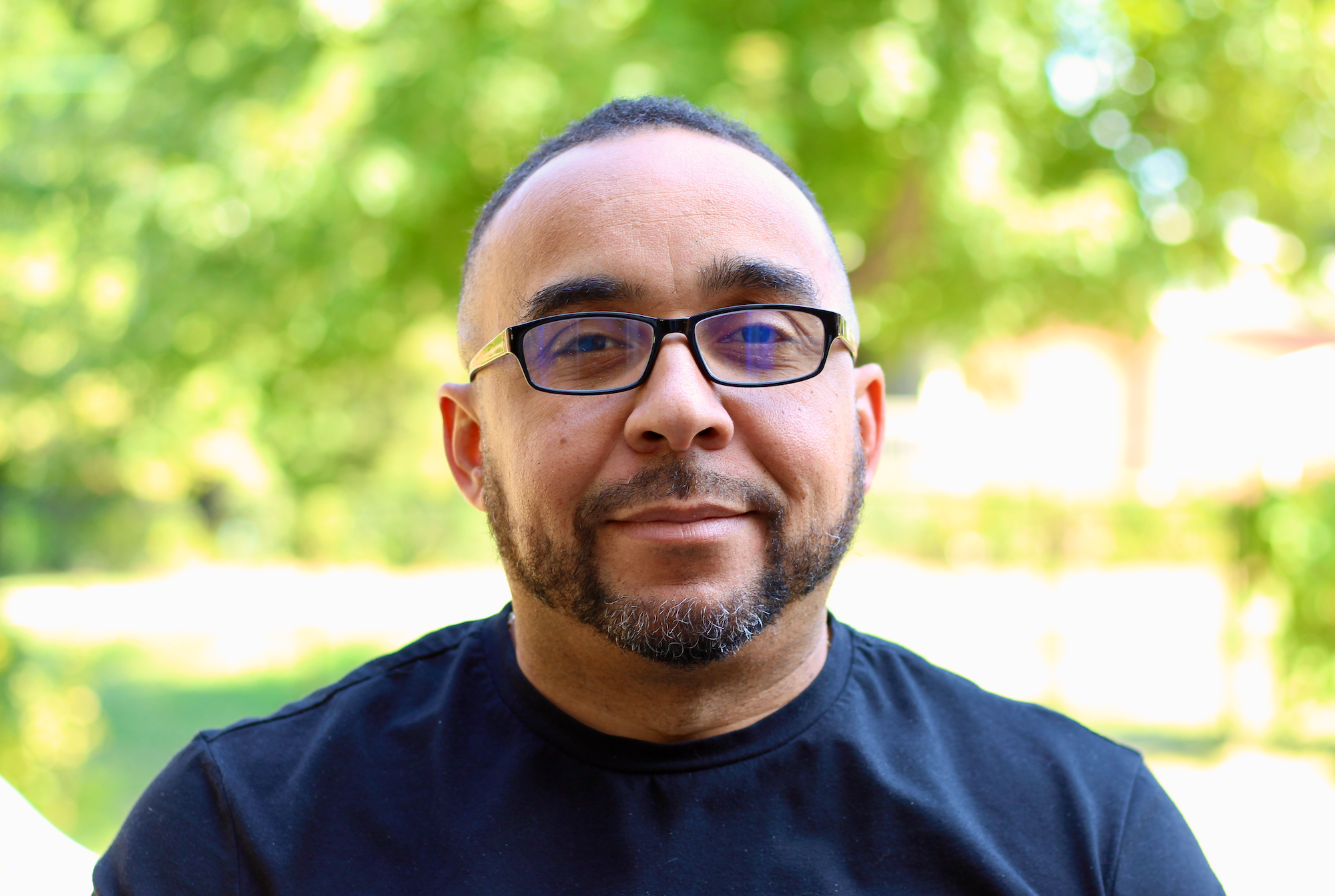
Ward Minnis, son of Eddie Minnis, at his home in Ontario, Canada. Photo by Shiemaa Khogali-Minnis
Minnis originally agreed to participate in the documentary after discussions with director Kevin Taylor in August 2023. Minnis was transparent about the strained relationship with his family due to religious differences and was assured that this aspect of the story would be given appropriate screen time. However, following last-minute edits—reportedly made at the request of Eddie Minnis, his father—Minnis’s narrative was significantly altered, only including an “artist’s journey” and omitting the deeper conflict that was central to his participation, reducing what was a thoughtful discussion of the issues to a single title card.
“The version of the film I saw and approved in June 2024 more accurately reflected my experiences,” said Minnis. “But the final release, which premiered at BIFF in December 2024, removed critical elements of my story, misrepresenting the truth in a way that benefits my father’s narrative rather than presenting an honest portrayal.”
Since the film’s release Minnis has repeatedly requested removal from the film, first addressing his concerns with the director, Kevin Taylor and then with his father, and later with executive producer Edgar Seligman, who initially appeared cooperative but has since taken no action.
“The current version of Ting an’ Ting is not what I agreed to, and it disregards my wishes,” Minnis stated. “Given the continued inaction, I am making my request public: I ask the filmmakers to remove me from this documentary immediately.”
In response to the misrepresentation of his story in the documentary Ward has prepared an expansive artistic experience to tell his side of the story set to begin on Tuesday, September 16th.
Minnis remains open to dialogue and will continue to push for the ethical resolution of this matter, but in the meantime, he has produced a full artistic response to the documentary, set to debut next week, that will tell his side of the story and go into depth about his relationship with his family and their relationship with Jehovah’s Witnesses.
“If you want a job done right, do it yourself” says Minnis. “Through my unfortunate experience with this film I have learned that I need to tell my own story, in my own way.” Minnis’ artistic response to the film will be simultaneously published on Facebook and on his website MentalSlavery.com with aspects of the experience touching multiple social media he says.
For media inquiries, please get in touch with Ward Minnis by using the MentalSlavery.com contact form.
The artistic response described in this release is called "Seven Skeletons" and is a limited series art experience that includes essays, a podcast, paintings, poetry and videos and can be found on this website. Visit the Table of Skeletons for the full ordered list.